On the 6th July 1907, the Irish Crown Jewels were discovered missing from their safe in Dublin Castle. The jewels, which are not linked to monarchy and instead belonged to the Order of Saint Patrick, consisted of a jewelled star and a diamond badge. Five gold encrusted collars belonging to knights of the Order were also stolen.
The Irish Crown Jewels
The Irish Crown Jewels belonged to the Order of Saint Patrick which was established in 1783 by George III during his reign as King of Ireland. The Order was to be the Irish equivalent of the English Order of the Garter or the Scottish Order of the Thistle. The Irish Crown Jewels were worn by the Sovereign at the investiture of new Knights as members of the Order, and by the Grand Master on other formal ceremonial occasions. The jewels were discovered missing four days before a visit by King Edward VII and Queen Alexandra during which it was planned to swear in The 2nd Baron Castletown into the Order.
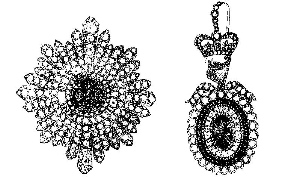
The Crown Jewels consisted of 394 jewels, most of which were taken from the jewellery of Queen Charlotte. The jewelled star was decorated with Brazilian diamonds and featured an emerald shamrock and ruby cross on a blue enamel background. The motto of the Order, ‘Quis Separabit MDCCLXXXIII’ was engraved in rose diamonds on the back.
The diamond badge featured an emerald shamrock on a ruby cross with a blue enamel circle. The Order’s motto was also engraved in rose diamonds on the badge and this was enclosed by a wreath of emerald shamrock’s. A crowned harp made from diamonds was placed on top of the badge.
The Theft
Since 1903 the jewels had been stored in a safe in a strong room of the Office of Arms which was located in Bedford Tower at Dublin Castle. The office was under the authority of the Ulster King of Arms, Sir Arthur Vicars, and was responsible for the care of all state insignia. Vicars and his staff held seven keys to the building, while Vicars also held the two keys to the safe containing the Crown Jewels.
The Crown Jewels were discovered missing on the 6th July, 1907 and were last seen on the 11th June when Vicars showed them to a visitor to the office. After the 11th June there were a number of security breaches in the building as both the building and strong room door were left open. The building cleaner also found an intruder in the room on one occasion. Vicars was known to get drunk while on overnight duty and once woke up to find the jewels around his neck. It is unknown if this was a prank or a trial of the actual theft. On another occasion Lord Haddo, the son of Lord Lieutenant, The 7th Earl of Aberdeen, stole the jewels and returned them to Vicars by post.
Investigation

Dublin Metropolitan Police (DMP) conducted an investigation and offered a reward of £1000. According to a leaflet distributed by the DMP, they believed that the thief used a fake key to gain access to the safe and steal the jewels since the safe lock had not been forced. Assistance was also received from Detective Chief Inspector John Kane of Scotland Yard. According to rumours, his report names the thief but this was suppressed by the Royal Irish Constabulary and never released.
Vicars publicly accused Francis Shackleton, brother of explorer Ernest Shackleton, of the theft. Although Shackleton was in financial difficulty and had the opportunity to make a copy of the safe key, he was not in Ireland at the time of the theft. The theory was that Shackleton planned everything but had an associate, Captain Richard Gorges, complete the theft. Both Shackleton and Gorges were homosexual, which was illegal at the time, and it is theorised that they were not investigated to avoid a greater scandal.
Theories were also put forward that the jewels were stolen by a republican or unionist group and Lord Haddo, who previously stole the jewels as a prank, was also accused. However no trace of the jewels has ever been found and no one has ever claimed responsibility for the theft.



 Irish Unresolved Mysteries